
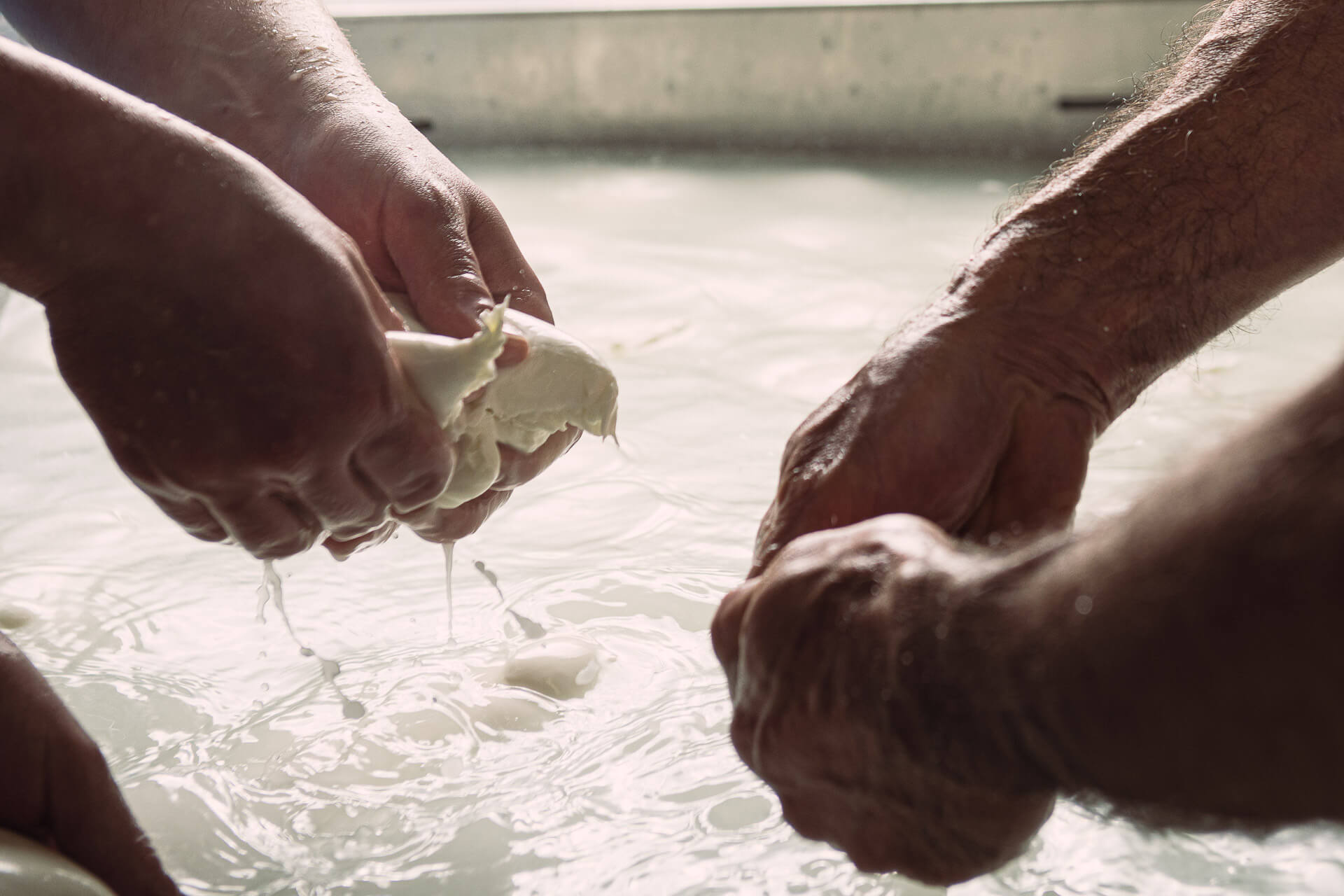
How Campanian Buffalo Mozzarella is Made
Every morning in Campania, at 5 AM, there's already a great buzz in the dairies, and you can smell that characteristic good aroma given by lactic ferments. Buffalo Mozzarella is a unique product whose exceptionality is linked to specific factors that make it an exclusive specialty of certain areas of Campania.
The milk, the artisanal processing practices, the climate, and the non-intensive farming methods are the fundamental elements that have given life to a truly inimitable product, despite attempts to reproduce it in other parts of the world.
Its name originates precisely from the practice of "mozzatura" (cutting).
How buffalo mozzarella is made
Buffalo milk, sourced exclusively from the pastures of the Campania Region, is a food with unique properties.
Its structure is composed of a quantity of proteins, fats, and calcium that allows for double the yield during processing compared to cow's milk or that of other animals.
For processing purposes, it is essential that the delivery times, from milking to processing, are very short to prevent the alteration of its qualities.
Once it arrives at the dairies with a certificate of origin and quality, the milk is brought to a temperature between 33 and 39°C, then transferred to large stainless steel vats, where it is cleaned of impurities through the filtration process.
It will then be coagulated thanks to the addition of whey, recovered from the previous day's processing, which acts as an activator of the coagulation process, through the use of natural calf rennet that helps the milk solidify.
This is followed by the processing of the curd, using the so-called "spino" (thorn), a tool for breaking up the lumps, which initiates the separation phase between the solid and liquid components of the milk (syneresis).
The liquid part is "sweet whey," while the solid part is called curd and must remain to acidify under whey until the cheesemaker deems it necessary. Meanwhile, it will rest on special tables to drain the residual whey.
When it is dry enough, it will be cut into strips and placed in "mastelli," typical wooden containers into which boiling water is poured while the cheesemaker continuously mixes it to test the tension of the paste for the subsequent stretching phase.
With the "saggio o prova" (test or proof) of the stretched curd, the maturation of the curd, its elasticity, softness, and density are then definitively established.
All that remains is to proceed with salting, which takes place in cooling tanks with the previous day's brining water. The process concludes with cutting the mozzarella into pieces.
Depending on the size and shape given to the stretched curd, mozzarella takes on various names and weights: those with a round shape are distinguished as ciliegine, bocconcini, perlina, ovolina, which vary by about 10 grams each up to the Aversana of about 800 grams; those with a braided shape (Treccia) can reach up to 3 kilos or, in smaller sizes, appear as nodini.
Furthermore, all types can also be offered in a smoked version using natural methods through the use of wheat straw.
Where it is produced
In Campania, the most important areas for Mozzarella production are:
The province of Salerno with the municipalities of: Albanella, Altavilla Silentina, Battipaglia, Bellizzi, Campagna, Capaccio-Paestum, Eboli, Fisciano, Nocera Inferiore, Nocera Superiore, Pontecagnano Faiano, Roccapiemonte, Sarno and Serre.
The province of Caserta with the municipalities of: Mondragone, Aversa, Calvi Risorta, Cancello ed Arnone, Carinola, Casal di Principe, Gricignano d’Aversa, Castel Volturno, Cellole, Lusciano, Falciano del Massico, Francolise, Grazzanise, Pastorano, Pignataro Maggiore, Santa Maria la Fossa, San Cipriano d’Aversa, Sessa Aurunca, Sparanise, Teverola, Villa Literno and Casapesenna;
As for the PDO, the areas indicated by the production specification include:
all the municipalities in the provinces of Salerno and Caserta;
the municipalities of Amorosi, Dugenta, and Limatola in the province of Benevento;
the municipalities of Arzano, Cardito, Frattamaggiore, Frattaminore, Mugnano di Napoli, Pozzuoli, and Qualiano in the metropolitan city of Naples.
Share