
How is ricotta cheese made
In Campania, saying ricotta implies a wealth of information about the taste and density of a much-loved dairy product.
While it was once very common in its more compact version, today more and more people love ricotta with a mousse-like consistency, making this cheese an extraordinary product very similar to a creamy mixture, so much so that it is frequently used in pastry making.
Once a simple dessert, after the world war it was served with a dusting of sugar and bitter cocoa, and then processed into other forms thanks to more refined recipes that allowed for the creation of more sophisticated preparations.
In the local Campanian tradition, it has always been used as a filling for pasta: cannelloni, ravioli, conchiglioni, and savory pies.
All production stages
Its name already encapsulates the characteristic of this dairy product: Ricotta is, in fact, re-cooked, obtained by reusing the whey from the previous cheese making process. It is therefore not obtained from curd and for this reason cannot be defined as a cheese but a dairy product.
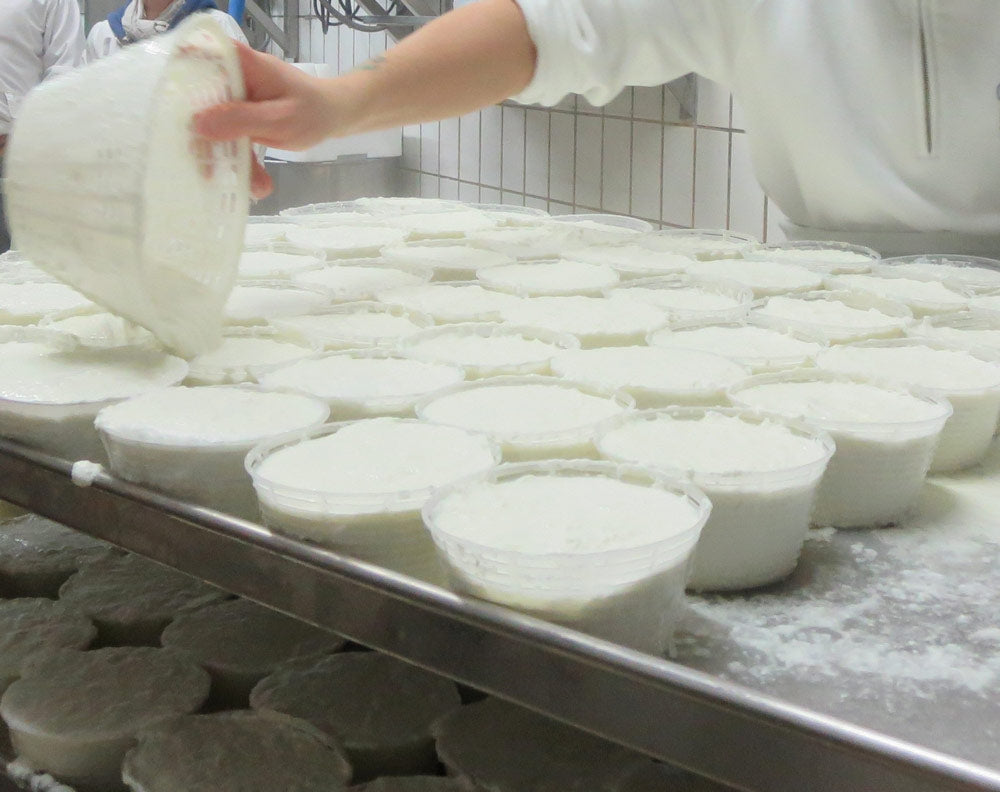
The whey must reach a temperature between 75 and 95 degrees to generate the reaction where the milk proteins will thicken into white curds which, thanks to a slotted spoon, can be collected and poured into the special baskets for filtering off the excess whey.
Here they will take on the classic shape that characterizes ricotta. The remaining whey is called "scotta" (scalded).
In Campania, there is also a further stage that gives rise to an even different product: hard or salted and baked ricotta, traditionally grated over pasta with tomato sauce.
An ancient history makes ricotta the true homemade dairy product
When ricotta was produced directly by shepherds, the processing involved heating the whey and waiting for the ricotta flakes to rise to the surface. They even used to mix spring or fountain water with seawater. Today, however, salts and acidic solutions (of citric acid, lactic acid, Epsom salt or Glauber's salt) are used to promote the thickening process. Only in small dairies, often family-run and still very numerous, are the ancient artisanal practices still respected. Moreover, it was common practice to produce ricotta at home every day with leftover and soured fresh milk: the excess liquid remaining after boiling the milk was left to sour overnight and a small part was used the next day to produce new ricotta.
What is the difference between ricotta made from buffalo, sheep, or cow's milk?
Ricotta has always been produced with all types of milk.
It is natural to wonder what the difference is between one product and another.
Buffalo milk certainly has the highest fat content compared to sheep's milk, which in turn contains higher quantities than cow's milk.
Consequently, the nutritional properties and energy value also change, for example:
- For 100g of buffalo ricotta, we will get approximately 212 calories, corresponding to 73% lipids, 20% protein, and 7% carbohydrates.
- For 100g of sheep ricotta, we will consume approximately 157 kcal with 9.87% carbohydrates; 65.92% fats; and 24.20% proteins.
- For 100g of cow ricotta, there will be 146 calories, 67% lipid intake, 24% protein, and 9% carbohydrates.
Share