
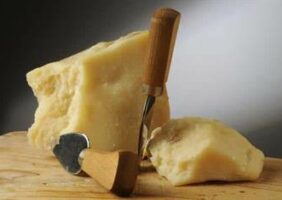
Typical Italian Cheeses: The Most Famous
Italy is among the European countries with the highest number of products recognized with the qualification of Protected Designation of Origin (PDO), Protected Geographical Indication (PGI) and Traditional Speciality Guaranteed (TSG). Many of these products are the most famous Italian cheeses; in fact, in Italy, each region has one or more typical cheeses, each with its particular taste and processing method. Listing all typical Italian cheeses in a single article is practically impossible. Below, we list only some of the typical Italian cheeses, the most well-known in Italy and abroad.
Pecorino
The term pecorino refers to all cheeses made from sheep's milk. In Italy, there are many different varieties of pecorino, but the most famous is certainly Pecorino Romano, whose area of origin is the Roman countryside. Pecorino Romano is one of the oldest cheeses in the world.
Asiago PDO
This is a typical cheese originating from the Asiago plateau (or of the Sette Comuni) which was already a renowned grazing area for flocks by the year 1000. Towards the end of the nineteenth century, the production of Asiago also extended to the foothills, the plain areas, and even the nearby Trentino mountain pastures. Each wheel bears the consortium mark with the creamery number, the province abbreviation, and the word "Asiago" imprinted on the rind.
Burrata
This is a stretched-curd cheese typical of the Puglia region, with production concentrated in the provinces of Bari and Taranto. It is enclosed within a pear-shaped stretched-curd pouch, with a smooth, shiny, white surface.
Grana Padano PDO
Grana Padano PDO is among the most famous Italian cheeses, one of the most renowned. It is a hard, cooked, slow-maturing cheese, produced from raw cow's milk coagulated by rennet. Being a natural food with high energy potential and containing many nutrients, it is suitable for the diet of children, adolescents, pregnant women, athletes, and the elderly.
Fontina D.O.P
Fontina is a fatty, semi-cooked cheese produced throughout the Aosta Valley, where the flowers, water, and herbs give the milk and cheese their unmistakable taste and aroma.
Mozzarella di Bufala Campana
Mozzarella obtained PDO recognition on June 12, 1996, under EU Regulation 1107/96. The term mozzarella derives from "mozzare," an operation consisting of the manual cutting of the stretched curd, performed with the index finger and thumb ("mozzatura"). It is a fresh, stretched-curd cheese known and renowned worldwide.
Caciocavallo Silano DOP
This is one of the oldest and most characteristic stretched-curd cheeses of Southern Italy. The most accredited theory on the origin of the name "caciocavallo" derives from the custom of hanging the cheese wheels, in pairs, straddling wooden poles placed near hearths. The name "silano," on the other hand, comes from the ancient origins of the product, linked to the Sila plateau.
Share